

Sports
Defying Gravity and Limits: Inside Ezra Frech and Daniella Karagach’s Historic First Perfect Ten on Dancing With the Stars
Oct
1. The First Perfect Ten: Ezra Frech and Daniella Karagach’s Historic Ballroom Breakthrough
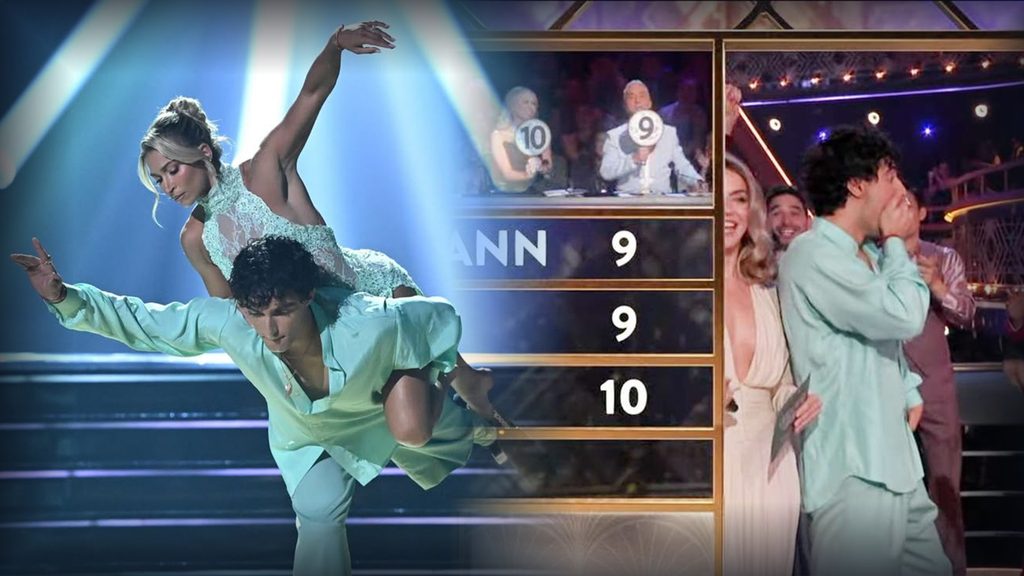
Inside the electric, pulse-pounding arena of the Dancing With the Stars soundstage in Los Angeles, Tuesday night’s live broadcast of Season 35’s ‘Dedication Night’ opened with an emotional atmosphere unlike anything witnessed in the long-running franchise’s twenty-one-year history. For six weeks, television audiences had watched celebrity contenders battle through intricate quicksteps, high-octane salsas, and glamorous cha-chas. But the moment twenty-one-year-old American Paralympic gold medalist Ezra Frech and his reigning champion professional partner Daniella Karagach stepped into the center of the hardwood ballroom, a solemn, reverent stillness settled over the studio.
Frech, who was born with congenital limb differences—missing his left knee, fibula, and all but one digit on his left hand—has spent his young life dismantling preconceived notions of physical possibility. Standing tall on his custom carbon-fiber prosthetic blade, dressed in a muted, earth-toned contemporary tunic that complemented Karagach’s flowing amber silk gown, Frech was not competing merely for scores or viewer votes. He was opening the evening with an intensely vulnerable, autobiographical contemporary routine set to the haunting, percussive folk anthem ‘Bloodline’ by rising singer-songwriter Mon Rovîa.
The contemporary dance discipline on Dancing With the Stars is renowned as the ultimate emotional canvas. Free from the rigid postural confinements of ballroom standard hold or the strict syncopation of Latin dance, contemporary allows choreographers to express the inner architecture of the human soul through raw athleticism, gravity-defying lifts, floor-bound floorwork, and visceral storytelling. Under the masterful, boundary-pushing guidance of Karagach—widely regarded by ballroom purists as the premier choreographic visionary of modern television—the routine shattered every technical and emotional expectation.
From the opening measures of Mon Rovîa’s acoustic fingerpicking, Frech moved with an astonishing fluidity, pivoting on his blade with seamless momentum, executing suspended airborne leaps, and supporting Karagach through breathtaking, inverted lifts that demanded superhuman core strength and unshakeable balance. Rather than camouflaging his physical differences, Karagach leaned directly into Frech’s unique movement language, crafting moments where Frech’s singular hand and blade became instruments of pure kinetic poetry.
The auditory landscape of the ballroom added to the sacred weight of the performance. Mon Rovîa’s ‘Bloodline’—with its raw, resonant acoustic chords, rhythmic heartbeat percussion, and aching vocal timbre—filled the cavernous soundstage, wrapping around the dancers like a protective cloak. In the wings of the stage, fellow competitors, including Julia Stiles, Tatyana Ali, and Tyler Cameron, watched in rapt, breathless silence, completely captivated by the profound vulnerability radiating from the dance floor.
Yet the emotional climax arrived when the routine broke the fourth wall of the competition. Mid-dance, the choreography guided Frech toward the edge of the ballroom perimeter, where his forty-nine-year-old mother, celebrated Iranian-American Hollywood actress Bahar Soomekh, stepped onto the dance floor. In a sequence that brought the entire studio audience to its feet, Frech enveloped his mother in an embrace of profound, trembling gratitude, completing a synchronized series of tender turns before gently escorting her back, culminating in a final, floor-bound tableau referencing the immortal children’s classic Love You Forever.
When the final musical chords faded into silence, the reaction was immediate and deafening. Co-host Alfonso Ribeiro, who has witnessed hundreds of routines across his championship run and hosting tenure, was visibly fighting back tears as he took the center stage. In the judging row, Carrie Ann Inaba, Derek Hough, Bruno Tonioli, and returning guest judge Kym Johnson were on their feet, openly weeping. Karagach, overwhelmed by the vulnerability of the performance, buried her head in Frech’s chest, sobbing as she asked him whether the choreography had done justice to his family’s journey.
When it came time for the judges to deliver their technical appraisals, guest judge Kym Johnson—a two-time Mirrorball champion who danced on Seasons 3 through 24 before returning to adjudicate—was breathless with reverence.
‘The first dance of the entire night, and you’ve got every single one of us crying up here,’ Johnson declared, her voice cracking with raw emotion. ‘The emotional connection, the physical connection to that dance was so overwhelmingly beautiful. Contemporary is all about finding your spiritual center, and then having the courage to extend completely beyond your perceived limits. Ezra, you did that with an ease and power that is simply unprecedented on this stage.’
When Johnson raised her score paddle, the studio erupted into a roar that shook the rafters: a pristine, golden paddle bearing the number 10. It marked the very first perfect ten awarded to any couple across the entirety of Season 35.
While veteran judges Carrie Ann Inaba, Derek Hough, and Bruno Tonioli awarded stellar nines—applauding the routine’s intricate musicality and demanding partnering—Johnson’s ten propelled Frech and Karagach to a spectacular 37 out of 40.
Flamboyant Italian judge Bruno Tonioli described the performance as ‘life-affirming’ and ‘a spiritual masterclass.’ Tonioli leaned over the desk, his eyes shining: ‘You really are a lesson to every single human being on this planet. The courage, the absolute fearlessness of your movement… And the dancing, by the way, was brilliant! It wasn’t merely inspiring; it was world-class contemporary dance.’
Carrie Ann Inaba addressed Bahar Soomekh directly in the audience, weeping as she spoke: ‘Bahar, the impact of the love, the sacrifice, and the belief you poured into your son has not only created a champion; tonight, it spread across this entire ballroom and touched millions of souls watching at home. That is the highest purpose of dance.’
Derek Hough, a six-time Mirrorball champion whose technical standards are notoriously rigorous, marveled at Frech’s core control and spatial precision. ‘Ezra, what you did physically in terms of weight transfer and partnering stability on that blade defies biomechanical logic,’ Hough noted. ‘You didn’t just meet Daniella halfway; you anchored the entire routine with the authority of a seasoned professional.’
In the post-dance interview with co-host Julianne Hough, Frech stood with an arm wrapped around Karagach, radiating serene gratitude. ‘My mom is my best friend, my therapist, my life coach all rolled into one,’ Frech shared, his voice steady with conviction. ‘She sacrificed her entire career so that I could have the surgeries, the therapy, and the confidence to stand here today. What an honor of a lifetime to share that dance floor with her.’
2. A Mother’s Ultimate Sacrifice: Inside Bahar Soomekh’s Departure from Hollywood
To fully comprehend the seismic emotional weight of Ezra Frech’s ballroom dedication, one must turn the clock back to the mid-2000s, when Bahar Soomekh was recognized as one of the most promising, critically acclaimed young actresses in American cinema.
Born in Tehran, Iran, into a devout Persian-Jewish family, Soomekh immigrated to Los Angeles with her parents and sister in 1979 amidst the turbulence of the Iranian Revolution. Possessing striking screen charisma, extraordinary intellectual depth, and fluent trilingual mastery of English, Persian, and Spanish, Soomekh pursued higher education at the University of California, Santa Barbara, earning a degree in environmental studies before answering the call of the performing arts.
By 2004, Soomekh had achieved a career breakthrough that many actors spend decades striving for. She was cast in director Paul Haggis’ complex ensemble drama Crash, portraying Dorri, the fiercely protective Persian-American daughter of shopkeeper Farhad (Shaun Toub). The film became a cultural phenomenon, winning three Academy Awards—including the coveted Oscar for Best Picture—and catapulting Soomekh into Hollywood’s premier spotlight. Working alongside an all-star ensemble including Don Cheadle, Sandra Bullock, Matt Dillon, and Brendan Fraser, Soomekh’s heartbreaking, grounded performance anchored the film’s most volatile emotional scenes. Critics universally praised her performance, and People magazine named her to their prestigious ‘100 Most Beautiful People’ list.
High-profile studio projects followed in rapid succession. In 2006, Soomekh starred opposite Tom Cruise and Philip Seymour Hoffman in the high-stakes summer blockbuster Mission: Impossible III, directed by J.J. Abrams, playing Davian’s translator, before taking on the demanding leading dramatic role of Dr. Lynn Denlon in the global horror phenomenon Saw III. In Saw III, Soomekh shouldered the psychological and emotional core of the film, delivering a visceral, exhausting dramatic performance that helped the movie gross over $160 million worldwide.
In an industry where female Middle Eastern performers were notoriously pigeonholed into one-dimensional, stereotyped roles, Soomekh was actively shattering barriers, commanding complex dramatic roles opposite Hollywood royalty. Studio executives were drafting multi-picture deals, and her artistic future appeared limitless.
Then, on May 11, 2005, Bahar Soomekh and her husband Clayton Frech welcomed their first child into the world: Ezra.
From his very first breath, Ezra faced extraordinary medical realities. He was born with congenital limb differences caused by a rare condition: his left leg lacked a fibula and knee joint, ending in a curved foot, while his left hand had only a single digit (a pinky finger). In the hospital maternity ward, doctors and genetic specialists presented a daunting, terrifying prognosis, preparing the young parents for a lifetime of severe immobility, medical uncertainty, and psychological trauma.
In that defining crucible, Bahar Soomekh made a radical, counter-cultural choice that completely defied the selfish norms of Hollywood stardom. Without hesitation, regret, or second thought, she walked away from her booming cinematic career.
Hollywood is an unforgiving town that quickly forgets actresses who step out of the casting rotation. Casting agents, producers, and managers urged Soomekh to hire full-time nursing staff so that she could maintain her red-carpet momentum and capitalize on the international box office success of Crash and Saw III. Soomekh refused. Recognizing that her son’s physical and emotional development required intensive, round-the-clock physical therapy, specialized orthopedic consultations, and an unshakeable maternal fortress of love, she chose her son over celebrity.
When Ezra was just two-and-a-half years old, his parents faced the most agonizing decision of their lives. Orthopedic surgeons at Shriners Hospitals for Children in Los Angeles recommended amputating Ezra’s lower left leg so that he could be fitted with an advanced prosthetic blade, while simultaneously performing a delicate surgical transplantation: removing a toe from his foot and grafting it onto his left hand to create a functional thumb.
The surgery was an grueling eleven-hour ordeal that tested the family’s spiritual and emotional limits. For months following the operation, Ezra underwent excruciating physical rehabilitation, enduring painful dressing changes, skin grafts, and prosthetic adjustments. Through every sleepless night, through every surgical recovery, Bahar was by his side, sleeping in hospital armchairs and singing softly to soothe his tears.
Night after night in hospital wards and pediatric clinics, Bahar would cradle her son and read from his favorite picture book, Robert Munsch’s 1986 children’s classic Love You Forever. She would softly sing the book’s timeless lullaby into his ear:
‘I’ll love you forever,
I’ll like you for always,
As long as I’m living,
My baby you’ll be.’
Those four lines became the family’s sacred mantra of resilience. Bahar did not treat Ezra as disabled or fragile; she instilled in him an unshakeable belief that his body was not broken, but uniquely designed for greatness. When Ezra expressed a childhood desire to play youth soccer, basketball, and track against able-bodied peers, Bahar and Clayton didn’t shield him from failure; they drove him to every practice, cheered from the sidelines, and taught him that external judgments could never diminish his divine inner worth.
When Ezra stepped onto the Dancing With the Stars ballroom floor twenty-one years later to dedicate his performance to Bahar, he was presenting the ultimate dividend of that maternal sacrifice. He was showing the world that behind every Paralympic gold medal and every historic television broadcast stands a mother who loved without condition, sacrificed without complaint, and believed in miracles before they ever had a name.
3. The Movement of Triumph: Deconstructing the ‘Bloodline’ Contemporary Choreography
The technical brilliance of Ezra Frech and Daniella Karagach’s contemporary routine cannot be overstated. In the pantheon of Dancing With the Stars routines, contemporary numbers can occasionally drift into vague, melodramatic pantomime, relying on exaggerated facial expressions and dramatic lighting rather than demanding movement fundamentals. What Karagach constructed for Frech, however, was an architectural masterclass in biomechanics, spatial balance, and storytelling through kinetic resonance.
Choosing Mon Rovîa’s acoustic track ‘Bloodline’ provided the ideal auditory foundation. Mon Rovîa, a Liberian-American singer-songwriter who spent his childhood fleeing civil war before finding refuge in the Appalachian mountains of Tennessee, writes music characterized by haunting, ancestral percussion, raw acoustic fingerpicking, and poetic lyrics exploring heritage, sacrifice, and survival. The song’s rhythmic cadence mimics the pulsing of an elevated heartbeat, establishing an urgent, driving momentum from the very first measure.
From a physiological perspective, contemporary partnering presents monumental challenges for an above-the-knee amputee dancer. In classical ballroom standard hold, a prosthetic blade can provide a predictable vertical anchor. But in contemporary dance, which demands deep pliés, rapid floor transitions, off-axis tilts, and unexpected decelerations, the lack of a biological left knee joint requires the dancer to generate balance and rotational torque entirely through the core abdominal muscles, hip flexors, and the right leg.
Karagach, whose reputation as a choreographic genius was forged through her historic, Emmy-nominated work with celebrity partners like Iman Shumpert and Jason Mraz, approached Frech’s physical instrument with reverence rather than limitation. Rather than choreographing around his prosthetic blade, Karagach made the blade a centerpiece of the movement narrative.
The dance opened with Frech positioned in a low, grounded crouch, his right hand gripping the hardwood while his left arm extended outward into the amber beam of an overhead spotlight. As Mon Rovîa’s vocals swelled with the opening lines of ‘Bloodline,’ Frech pushed off the floor with explosive, cat-like agility, launching into a sweeping series of circular floor rolls that transitioned seamlessly into a standing extension.
The partnering work that followed was breathtakingly complex. In one particularly daring sequence, Karagach initiated a high-speed spin into Frech’s frame. Frech caught her with his right arm while supporting her weight against his chest, executing a suspended, 360-degree rotational lift where Karagach’s body floated parallel to the floor like a bird in flight. To execute such a lift on a prosthetic blade requires millimeter-precise weight distribution; a deviation of two degrees in foot placement could result in catastrophic loss of balance. Frech executed the movement with absolute, rock-solid serenity.
Equally remarkable was the intentionality Karagach brought to Frech’s upper body. Dancers with limb differences in their upper extremities often struggle with arm lines and finger extensions, which are crucial for projecting classical symmetry in contemporary performance. Karagach turned Frech’s single-digit left hand into an emotional focal point. In several poignant motifs throughout the routine, Frech would reach toward the heavens or touch Karagach’s shoulder with that hand, highlighting the beauty and sacred individuality of his anatomy.
The choreography’s spatial geometry was meticulously designed to mirror the arc of childhood development. In the first half of the dance, Frech and Karagach danced in close, interdependent proximity—symbolizing a child seeking stability from a guiding parent. As the percussion intensified in the second half, Frech broke away into powerful, expansive solo leaps across the center floor, demonstrating self-actualization, independence, and athletic mastery. His leaps into the air showcased the staggering vertical propulsion that made him a world-record high jumper.
Then came the routine’s transcendent emotional bridge: Bahar’s entrance. Rather than treating her presence as a passive spectator cameo, Karagach integrated Bahar directly into the phrasing. Frech moved to the ballroom edge, took his mother’s hands, and led her into three gentle, circular waltz turns. The lighting softened to a warm, candlelit glow, emphasizing the profound intimacy of the mother-son gaze. When Bahar gently pressed her forehead against Ezra’s before stepping back, the entire soundstage was suspended in sacred silence.
The routine concluded with Frech returning to the center floor beside Karagach. In the final seconds, Frech knelt upon the floor, pulling his knees to his chest and resting his head upon Karagach’s lap, while Karagach gently stroked his hair in exact visual homage to the final illustration of Love You Forever.
It was a performance that bridged the worlds of elite Paralympic athletic discipline and high-art theatrical contemporary dance, proving that true artistry does not depend on biological uniformity, but on the depth of the soul speaking through the flesh.
4. Beyond the Blade: Ezra Frech’s Odyssey from Pediatric Amputee to Double Paralympic Champion
To television viewers who only know Ezra Frech through his triumphant weekly performances on Dancing With the Stars, his ballroom poise might appear to be the natural gift of a charismatic young entertainer. In reality, Frech’s radiant confidence was forged in the fire of grueling athletic competition, endless physical rehabilitation, and a relentless crusade to redefine how the world views adaptive athletes.
Frech’s journey into elite sports began almost the instant he was fitted with his first running blade at the age of eight. Growing up in Los Angeles, he refused to be segregated into passive recreational activities. He played competitive basketball, flag football, and soccer against non-disabled peers, frequently enduring cruel stares, whispered mockeries on public playgrounds, and the skepticism of league administrators. Rather than retreating into isolation, Frech channeled that adversity into ferocious competitive drive.
Recognizing that millions of children with physical disabilities across the United States lacked access to expensive adaptive sports equipment and coaching, Ezra and his father Clayton co-founded Angel City Sports in 2013, when Ezra was just eight years old. What began as a modest community sports clinic has grown into one of the nation’s premier adaptive sports organizations, providing free sports training, mentorship, and high-performance Paralympic equipment to thousands of disabled youth, adults, and military veterans across Southern California and beyond. Through Angel City Sports, Frech has personally helped thousands of young amputees receive their very first running blades, empowering them to run, jump, and dream without limitation.
By his teenage years, Frech realized that his true calling lay in track and field—specifically the high jump, long jump, and sprint events in the T63 classification (for athletes with single above-the-knee amputations or equivalent limb differences). In the high jump, an above-the-knee amputee must generate massive horizontal approach speed, plant on a flexible carbon-fiber blade, convert that speed into vertical lift, and manipulate their body over a fiberglass bar without knocking it off with their prosthetic limb. It is universally considered one of the most mechanically demanding disciplines in all of track and field.
Frech’s ascent through the international ranks was meteoric. At just fourteen years old, he represented the United States at the 2019 Parapan American Games in Lima, Peru, winning two silver medals in the high jump and long jump. Later that year, he qualified for the 2019 World Para Athletics Championships in Dubai, competing as the youngest athlete on the national team.
At sixteen, Frech achieved his childhood dream by qualifying for the pandemic-delayed Tokyo 2020 Paralympic Games. Competing in a cavernous, empty Olympic Stadium in Tokyo, Frech placed fifth in the high jump, clearing 1.80 meters. While a top-five finish at sixteen was hailed as a brilliant Olympic debut, Frech was heartbroken. He returned to Los Angeles with an obsessive, burning determination to stand atop the podium in Paris.
Over the next three years, Frech trained with monastic discipline, balancing brutal weightlifting sessions, track sprints, and high jump biomechanics. In July 2023, at the World Para Athletics Championships in Paris, Frech stunned the international sporting community by setting a new World Record in the High Jump T63, clearing a breathtaking 1.95 meters (6 feet, 4.75 inches)—leaping over a bar significantly higher than his own head.
Then came the crowning glory of the Paris 2024 Paralympic Games.
On September 2, 2024, inside the thunderous, roaring Stade de France packed with 70,000 screaming spectators, Frech lined up in Lane 8 for the Men’s 100-meter T63 final. Entering the race as a decided underdog against seasoned international sprint specialists, Frech exploded out of the blocks. Trailing by two full meters at the 50-meter mark, Frech unleashed an electrifying, historic late-race surge, tearing past his competitors with piston-like blade strikes to lunge across the finish line in a blistering personal best of 12.06 seconds. He had won Paralympic Gold by just two-hundredths of a second.
Less than twenty-four hours later, Frech returned to the infield for the Men’s High Jump T63 final. With the weight of the sporting world on his shoulders, Frech delivered a flawless, masterclass performance, soaring over 1.94 meters to capture his second Paralympic Gold Medal of the Games and setting a new Paralympic Record. At nineteen years old, Ezra Frech had become a double Paralympic Champion and a global icon of human resilience.
When ABC announced that Frech would join Season 35 of Dancing With the Stars, skeptics wondered whether an elite track athlete could adapt to the delicate musicality, fluid hip action, and theatrical pageantry of the ballroom. From Week 1, Frech silenced every doubter. His fierce athletic conditioning, laser-focused work ethic, and complete lack of fear made him a dream partner for Daniella Karagach.
In bringing that same championship mindset to the contemporary floor on Dedication Night, Frech achieved something far greater than athletic medals: he demonstrated that human dignity, grace, and artistic beauty reside not in the uniformity of our bodies, but in the indomitable power of our spirits.
5. ‘Love You Forever’: Redefining Disability, Family Devotion, and the Soul of Ballroom Competition
The seismic cultural resonance of Ezra Frech and Daniella Karagach’s Dedication Night contemporary performance extends far beyond the television ratings of Dancing With the Stars. It marks a watershed moment in the representation of disability and parental love on mainstream American broadcast television.
For decades, network television has struggled with the portrayal of individuals with physical disabilities, frequently oscillating between two patronizing extremes: the tragic, helpless victim deserving of pity, or the two-dimensional ‘inspiration porn’ caricature whose mere physical existence is praised without regard to actual skill or artistic merit.
What Ezra Frech and Daniella Karagach accomplished on Tuesday night completely shattered that patronizing paradigm.
Frech did not earn the season’s first perfect ten because he is an amputee; he earned it because his contemporary routine was an exquisite, world-class artistic masterpiece that out-danced, out-lifted, and out-expressed every competitor in the ballroom. When Kym Johnson raised that golden paddle bearing the number 10, she was honoring technical precision, breathtaking musicality, and flawless emotional storytelling. Frech proved that disabled artists do not need lowered standards or charitable grading; when given visionary choreography and equal platforms, they are fully capable of setting the standard for excellence.
Equally revolutionary was the routine’s celebration of maternal devotion. In a modern culture that frequently devalues domestic caregiving, celebrates hyper-individualism, and views parental sacrifice through a lens of personal diminution, the story of Bahar Soomekh offers a radiant, counter-cultural testimony to the transcendent power of maternal love.
Soomekh did not view walking away from Hollywood as a tragic sacrifice; she viewed it as the highest, most rewarding casting call of her life. By investing her days, her energy, and her heart into her son’s physical healing and moral foundation, she did not merely raise a champion athlete; she forged a young man of profound humility, eloquence, and generosity who uses every public platform to uplift others.
When Frech concluded the dance with that quiet, floor-bound homage to Love You Forever, the millions of parents watching across the world felt an acute, cathartic pang of universal recognition. Every parent who has ever spent a sleepless night in a hospital pediatric wing, every mother who has wiped away tears of frustration at a kitchen table, and every father who has fought for their child’s dignity in a world that can be cruel and unforgiving saw their own quiet, uncelebrated devotion reflected on that ballroom floor.
As the credits rolled on Tuesday night’s broadcast, the viral momentum of Ezra Frech’s performance was already sweeping across TikTok, X (formerly Twitter), and Instagram, accumulating millions of views, heartfelt tributes from fellow Olympians and Hollywood celebrities, and personal messages from disabled children across the globe who saw, for the first time in their lives, someone who looked like them standing center stage under a shower of golden confetti, celebrated as the greatest dancer in America.
The ballroom floor of Dancing With the Stars has witnessed many champions hoist the Mirrorball Trophy over twenty-one years. But trophies gather dust, and television seasons inevitably fade into archival memory. What Ezra Frech and Bahar Soomekh gave the world on Dedication Night is permanent.
They reminded a fractured, anxious world that love is not an abstract sentiment; love is an active, sacrificial choice. Love is an eleven-hour surgery in a pediatric hospital; love is driving to track practice before dawn; love is stepping away from the glamour of movie sets to cradle a weeping child; and love is holding hands on a ballroom floor twenty-one years later to prove that together, there is no limit that cannot be shattered.
As long as music plays and human beings dare to dream, the memory of Ezra Frech’s contemporary leap into the light will endure. He did not merely dance to Mon Rovîa’s ‘Bloodline’—he redefined the power of what bloodlines can achieve when bound together by unconditional, eternal love.
From: Zyvellofashion

